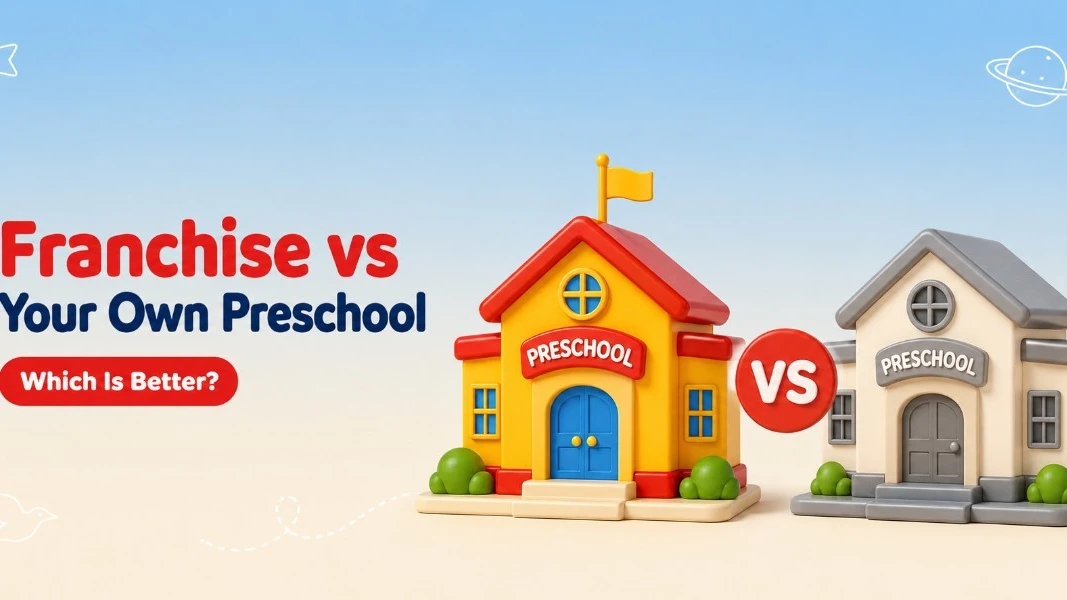
Preschool Franchise vs Starting Your Own Preschool: Which Should You Choose?
Preschool franchise vs own preschool, compared on cost, brand trust, training, royalty and break-even, with a clear rule for choosing between the two.
campaign
Sponsored ContentThis article is paid promotional content submitted by a third party. It has not been produced or independently verified by the Attention India editorial team.
Rahul VarunVerified Public Figure • 30 Apr, 2026Editor
“Preschool Franchise vs Starting Your Own Preschool: Which Should You Choose?”
Read more onattentionindia.com/s/458ca5
3 Sep 2026
https://attentionindia.com/s/458ca5
Copied
A preschool franchise buys you a ready brand, curriculum and training system, while an independent preschool gives you full control and no ongoing royalty. The right choice depends on your early childhood experience, your capital cushion in year one, and how well known you already are in your locality. Neither route is automatically safer. This comparison looks at what each model demands, where each one wins, and how to decide.
Should you buy a preschool franchise or start your own preschool?
Buy a franchise if you are new to education and want ready systems. Start your own if you are an experienced educator with local reputation and tight capital.
The two models solve different problems. A franchise reduces uncertainty by supplying a tested curriculum, teacher training and an operating playbook, in exchange for a brand fee and a royalty. An independent preschool removes those payments, but transfers every decision back to you.
Get Featured Today!
Get featured your news, press release, success story and more on Attention India. You can feature on Magazine, Article, Social Media Post, Biography and more.
Most first-time investors in India are not educators. They are professionals, homemakers or small business owners who want a stable business near home, and for them a franchise shortens the learning curve. For a trained teacher or an experienced principal, the same support is worth much less.
A preschool franchise in India typically needs roughly 8 to 30 lakh rupees depending on city, format and brand (this breakdown of preschool franchise costs in India shows how the components add up), plus working capital for three to six months of running cost. An independent centre can start below that band, but the saving shrinks once curriculum, materials, training and marketing are paid for out of pocket.
What does an independent preschool save you, and what does it cost you?
An independent preschool saves the brand fee and the ongoing royalty, but you must build curriculum, teacher training, admissions systems and parent trust from zero.
The saving is easy to calculate. No franchise fee at signing, no royalty on monthly revenue, no mandated spend on approved vendors or fixed interiors. Over five years that royalty adds up, and it is the strongest financial argument for going independent.
The invisible cost is harder to see. You are now responsible for a developmentally sound curriculum, lesson plans, learning material, teacher training and every piece of marketing. Each is a project, and done badly they show up as parent complaints, not as a budget line. This list of common first-time preschool owner mistakes covers several of the ways that shows up in practice.
There is also the trust gap. A parent choosing where to send a three-year-old decides emotionally, and a known brand is a shortcut for that decision. An unknown name earns the same confidence through visits and word of mouth, which takes time you are paying rent through.
Comparison point
Preschool franchise
Independent preschool
Upfront cost
Higher, brand fee included, roughly 8 to 30 lakh rupees
Lower at signing, but curriculum and marketing cost comes later
Brand trust in year one
Borrowed from the network, easier first admissions
Built from zero, rests on your local reputation
Training and systems
Supplied and updated by the brand
You design and document everything yourself
Ongoing fees
Royalty, often a marketing contribution too
None, full margin retained
Freedom on curriculum and fees
Limited by brand standards and pricing bands
Complete, change fees, timings or pedagogy any time
How different is the first year in each route?
The first year differs most in admissions and hiring, where a franchise supplies proof and process, and an independent founder supplies personal credibility instead.
Admissions is the sharpest difference. Franchise partners open with brand collateral, a standard enquiry process and a recognisable name on the board. Independent founders usually open with a smaller first batch and grow through referrals from families who already know them.
Hiring comes next. Good preschool teachers are scarce almost everywhere in India, and both models compete for the same pool. A franchise routes new teachers through a structured induction. An independent school must hire someone already trained, which costs more, or build the training itself, which costs time.
Timelines differ too. A franchise commonly takes three to six months from signing to opening, because approvals, layout and training follow a set sequence. An independent setup can be quicker if you already have a property and a plan, or much slower if you design the programme while renovating.
Franchise year one is mostly execution against a given plan, with the brand answering process questions.
Independent year one is design plus execution, so founder time is the scarcest resource.
Both routes need licences that vary by state and municipal body, so confirm current requirements with your local authority before signing a lease.
Which route is faster to break even, and why?
Franchises usually reach break-even sooner because enrolment ramps faster, while independents keep more of each rupee but take longer to fill seats.
Break-even for a preschool typically falls in the 18 to 30 month range, and both models sit inside that band. A franchise tends to fill classrooms faster because of brand recall, so revenue rises earlier even though royalty trims each rupee. An independent centre keeps the full fee but takes longer to fill.
The real comparison is occupancy speed versus margin retained. If you can fill seats quickly on your own name, independent wins on economics. If not, the royalty is the price of faster occupancy. Industry-reported operating margins for a mature centre fall in the 20 to 35 percent range, and both models can reach that once seats are full.
What happens if things go wrong in each model?
A franchise gives you someone to call when enrolment stalls or a parent issue escalates, while an independent operator solves the same problems alone.
Problems in a preschool are rarely dramatic. They are a weak admission season, a teacher resigning mid-term, a complaint spreading on a residential WhatsApp group, or a competitor opening nearby. A franchise partner can escalate these and draw on how other centres handled the same thing.
An independent operator has no such channel, but also needs no permission. She can drop fees, change timings, add a daycare wing or rework the curriculum the same week. Speed of response is the independent model's real defence, and for an experienced educator it is often enough.
Support quality varies widely across franchisors, so this advantage is not automatic. Larger and older networks usually have more field staff than very small chains, but that is a matter of structure, not a guarantee of attention in your city. Ask existing partners in your city what happened the last time enrolment dipped, and how long the brand took to respond.
So which one should you pick?
Choose a franchise if you lack sector experience or brand recall in your city. Choose independent if you are an experienced educator with local trust and limited capital.
Score yourself on four things: early childhood experience, local reputation among parents, capital available beyond setup cost, and tolerance for uncertainty. Strong on experience and reputation points to independent. Weak on either, especially in a metro where several known brands already operate, points to franchise.
City matters more than most investors realise. Where parents actively compare brands, an unknown name faces a harder first year. In smaller towns and newer residential pockets, a respected local educator can out-compete a national brand, because the relationship matters more than the logo.
A middle path also exists. Some operators start with a franchise, learn the operating discipline over one full cycle, then open independent centres later, similar to the phased approach in this franchise growth playbook for owners. It converts fees paid to a brand into knowledge you keep.
Frequently asked questions
Is a preschool franchise always more expensive than an independent preschool?
At signing, yes, because of the brand fee. Over the full setup the gap narrows once you pay for curriculum, training, materials and marketing yourself.
Can I convert my independent preschool into a franchise later?
Many brands accept conversions, subject to an audit of your premises, staff and processes. Terms vary, so ask before you build anything you may have to redo.
Do I need a teaching background to run either model?
Not strictly, but it matters far more in the independent route, where you personally set academic standards. Franchise partners can rely on the brand's curriculum and training.
What licences does a preschool need in India?
Requirements differ by state and municipal body and change over time, covering registration, fire and health clearances. Confirm the current list with your local authority.
Which model is better if I have very limited capital?
Independent avoids the brand fee, but plan for a slower fill rate. Some brands sit near the bottom of the 8 to 30 lakh rupees band, so compare both before deciding.
Author Bio
Written by an independent education-sector analyst who studies India's early-education franchise market, including brands such as EuroKids, Kidzee, Little Millennium and Shanti Juniors.
Rahul VarunVerified Public Figure • 30 Apr, 2026Editor
Rahul Varun is an Editor at Attention India, contributing to the development and publication of engaging news and feature stories. He focuses on clear storytelling, editorial quality, and presenting information in an accessible and reader-friendly manner.