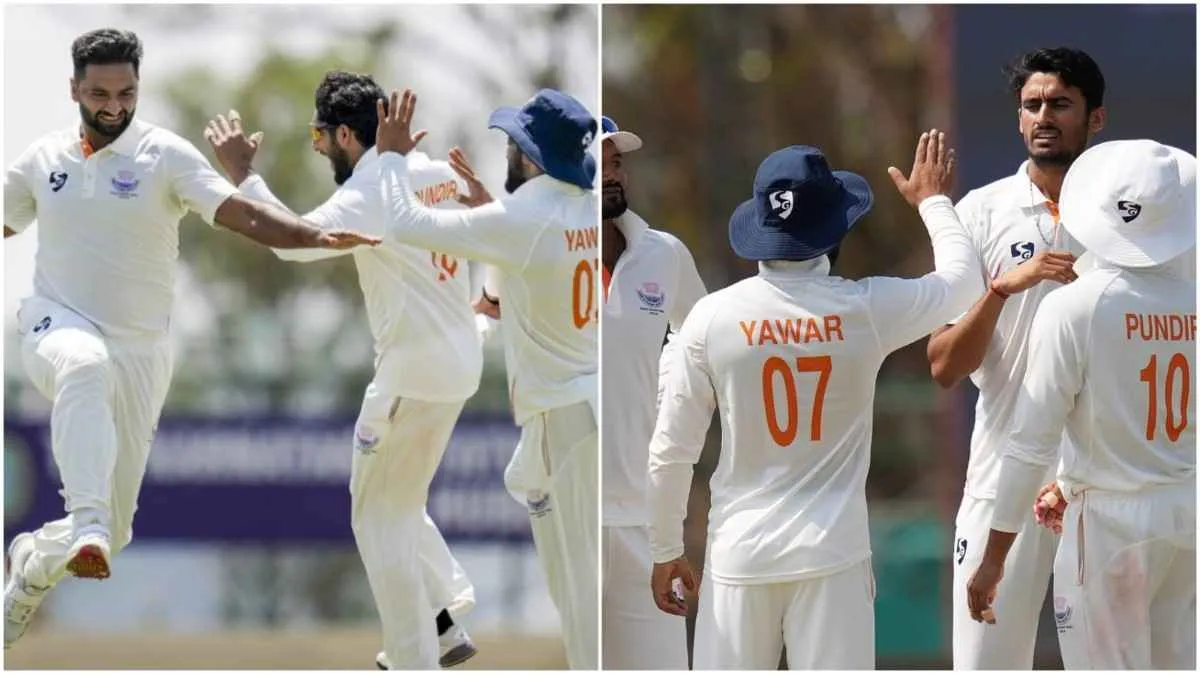
For a side that spent decades being seen as outsiders in India’s premier domestic competition, this victory is more than just a trophy — it’s validation, belief, and a new beginning.
How the Final Unfolded
The Ranji Trophy final ended in a draw, but Jammu and Kashmir emerged champions on the strength of a commanding first-innings lead over Karnataka — a team stacked with India Test stars and widely tipped to win.
Batting first in Hubballi, J&K piled on a massive 584 runs. The foundation was laid by Shubham Pundir’s composed 121 off 247 balls, supported by valuable contributions from Yawer Hassan (88), captain Paras Dogra (70), Abdul Samad (61), Kanhaiya Wadhawan (70) and Sahil Lotra (72). It was not a one-man show — it was a collective effort, built patiently and confidently.
Karnataka fought back through captain Mayank Agarwal’s impressive 160, but fast bowler Auqib Nabi produced the spell of his life. His figures of 5 for 54 — including the prized wickets of KL Rahul, Agarwal and Karun Nair — shifted the momentum firmly in J&K’s favour.
In the second innings, Qamran Iqbal’s unbeaten 160 off 311 balls, along with Sahil Lotra’s 101, ensured there would be no late drama. When the teams shook hands, J&K had stretched their overall lead to 633 runs — leaving no doubt about who had dominated the contest.
A Journey 67 Years in the Making
Jammu and Kashmir played their first Ranji match in 1960. Their first-ever win came only in 1982 — in their 99th match. For decades, victories were rare, and expectations were even rarer. This final was their 346th match in the tournament — and just their 47th win.
But the signs of progress had been visible. Quarterfinal appearances in 2013–14, 2019–20 and 2024–25 hinted at steady growth. The 2025/26 season felt different from the beginning. They lost only one game all season, against Mumbai in Srinagar.
Karnataka’s Missed Opportunity
Karnataka entered the final as favourites. With experienced internationals in their ranks, they were expected to dictate terms. Yet across five days, they were constantly playing catch-up. By the final day, the gap had grown so wide that even frontline batters like Rahul, Agarwal and Karun Nair were seen bowling — a rare sight that reflected how far the game had drifted away from them.
For Karnataka, this will be a painful defeat. For J&K, it will be remembered as the week everything changed.
What This Win Could Mean
This victory could mark the beginning of a new era for cricket in Jammu and Kashmir.
Young players in the region now have proof that success is possible.
Increased investment and infrastructure support may follow.
National selectors may look more closely at talent emerging from the state.
The psychological barrier — the feeling of being perpetual underdogs — has been shattered.
Winning once is special. Sustaining success will be the real challenge. Opponents will no longer take them lightly. Expectations will rise. Pressure will grow.
But for now, none of that matters.
For a team that waited 67 years for this moment, the Ranji Trophy is not just a symbol of victory. It is a reminder that persistence, patience and belief can eventually bend history in your favour.