From a Hospital Corridor to a Platform How One Caregiver's Promise Became EncoEase
campaign
Sponsored ContentThis article is paid promotional content submitted by a third party. It has not been produced or independently verified by the Attention India editorial team.
Rahul VarunVerified Public Figure • 30 Apr, 2026Editor
calendar_today May 11, 2026schedule 5:24 PMchat_bubble 0
P
Press Release
NEWS CARD
“From a Hospital Corridor to a Platform How One Caregiver's Promise Became EncoEase”
Read more onattentionindia.com/s/6f0fe4
11 May 2026
https://attentionindia.com/s/6f0fe4
Copied
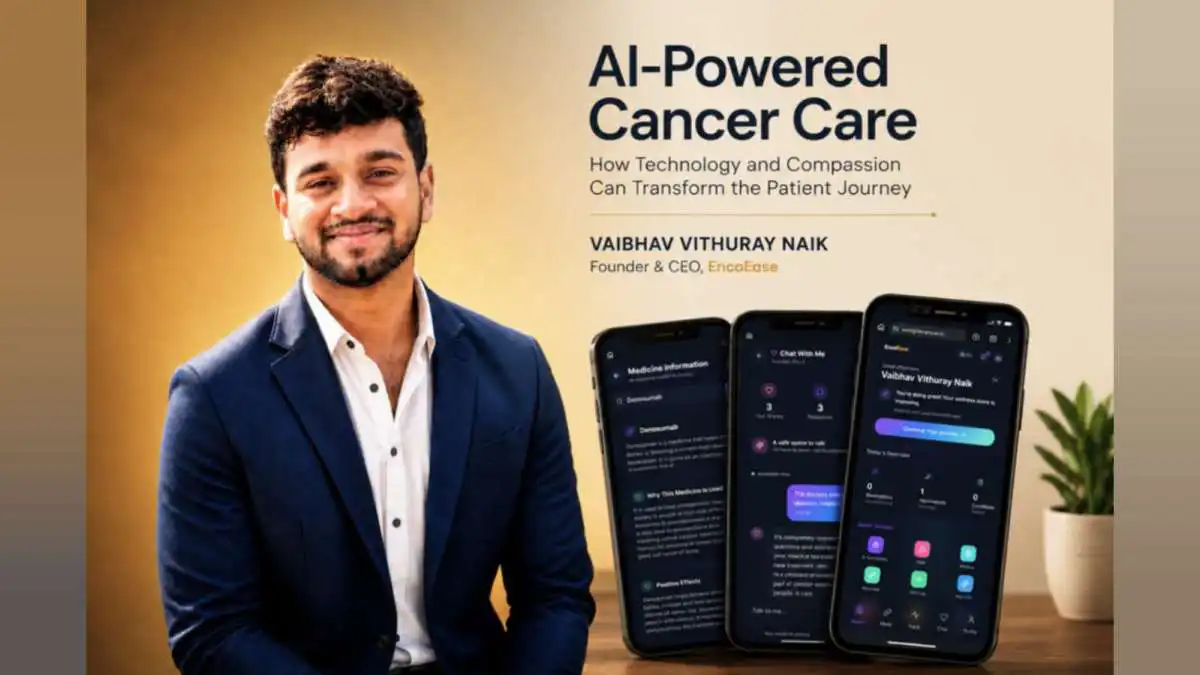
A Goa-based founder is using personal loss and lived experience to fill one of cancer care's most overlooked gaps the silence between hospital visits.
When Vaibhav Vithuray Naik's father was diagnosed with Stage 4 cancer in 2020, at the height of the pandemic, the family found itself navigating one of life's most harrowing journeys with very little guidance. Vithuray Rama Naik a man his son describes as "warmth, in human form," a lover of theatre and comedy suddenly became a cancer patient. And Vaibhav became his caregiver.
What followed was five years of chemotherapy, setbacks, hospital visits across multiple facilities, and the relentless administrative chaos that cancer families know all too well: heavy bags stuffed with files and reports, medical terminology that few outside medicine could easily decipher, and the hollow feeling of walking out of a hospital with a bag of prescriptions and no one to call at two in the morning. "It was not just tiring," Vaibhav recalls. "It was demoralising." Out of that desperation, the family cobbled together a rudimentary app on a laptop locally stored, nothing sophisticated just to track medicines, log reports, and feel some semblance of control. It was never meant to be a product. It was a lifeline.
Get Featured Today!
Get featured your news, press release, success story and more on Attention India. You can feature on Magazine, Article, Social Media Post, Biography and more.
Vithuray Rama Naik passed away on 20th November 2025. Before he did, he left his son with words that would become the founding philosophy of a platform: "Help as many people as possible… even the smallest help matters in this situation."
That platform is EncoEase.
What EncoEase Does and What It Doesn't
EncoEase is a digital support companion designed specifically for cancer patients and their caregivers. The name says it plainly: Enco from oncology, Ease because, as Vaibhav puts it, "that is what patients and families deserve most, and receive least."
The platform does not diagnose. It does not prescribe. It does not attempt to replace the oncologist. What it does is fill the gap that opens the moment a patient walks out of the hospital a gap that, for millions of families, feels like falling off a cliff. At its core, EncoEase is built around an AI-powered care assistant available around the clock. Patients can log symptoms of daily pain, fatigue, nausea, emotional state and the system analyses those entries over time to surface patterns rather than isolated data points. Is a symptom recurring? Is fatigue worsening since the last treatment cycle? These insights, the platform argues, are genuinely useful for both patients and their treating teams. A conversational chat feature allows patients to ask questions about their treatment at any hour, in plain language, and receive responses designed to be calm and compassionate rather than clinical. Prescription information is explained in terms families can actually understand. Hospital and financial aid finders help users navigate a healthcare ecosystem that many simply do not know how to access. Crucially, Vaibhav has made the platform completely free. "Not freemium. Not free for 30 days. Free," he states. The reason is straightforward: his father's words left him no other option.
Building Trust in Healthcare Tech
For any AI-driven health platform, the question of safety and accuracy is non-negotiable. Vaibhav is candid about where EncoEase currently stands. The platform is designed with clear AI boundaries it recognises when a question requires professional medical attention and redirects users accordingly. Formal validation with oncology professionals is actively in progress, and the product roadmap includes deeper integration with hospital systems and partnerships with cancer foundations and NGOs. User feedback, for now, is gathered through email and direct messaging, an admittedly informal process, but one rooted in something many startups lack: genuine proximity to the problem. The early version of EncoEase was used by a real cancer patient, in a real crisis, for five real years.
What Comes Next
The feature that most excites Vaibhav is still being built: an in-platform fundraising ecosystem that allows patients, caregivers, and supporters to contribute to a verified cancer patient fund. In India, where treatment costs can push families into severe debt, and where patients sometimes discontinue chemotherapy not because they lack the will to fight but because they cannot afford to continue, the stakes are viscerally high. EncoEase is also working on expanding language support to include regional Indian languages a recognition that the patients who most need this kind of support are often the least served by English-only digital tools. For Vaibhav Vithuray Naik, a freelancer and educator from Margao who teaches AI and film science to college students, this platform is not a pivot or a pitch. It is a promise kept.
"When a patient walks out of the hospital," he says, "they shouldn't feel like they've been left behind.
EncoEase is currently available as a free platform for cancer patients and caregivers.
Rahul VarunVerified Public Figure • 30 Apr, 2026Editor
Rahul Varun is an Editor at Attention India, contributing to the development and publication of engaging news and feature stories. He focuses on clear storytelling, editorial quality, and presenting information in an accessible and reader-friendly manner.