
James D. Watson, DNA Pioneer and Controversial Scientist Behind the Double Helix Discovery, Dies at 97
James Watson, the American scientist who shared a 1962 Nobel Prize for discovering the structure of DNA has died. He was 97 years old. He died on Thursday in East Northport, N.Y., on Long Island, his son Duncan said.
 Aadrika Tayal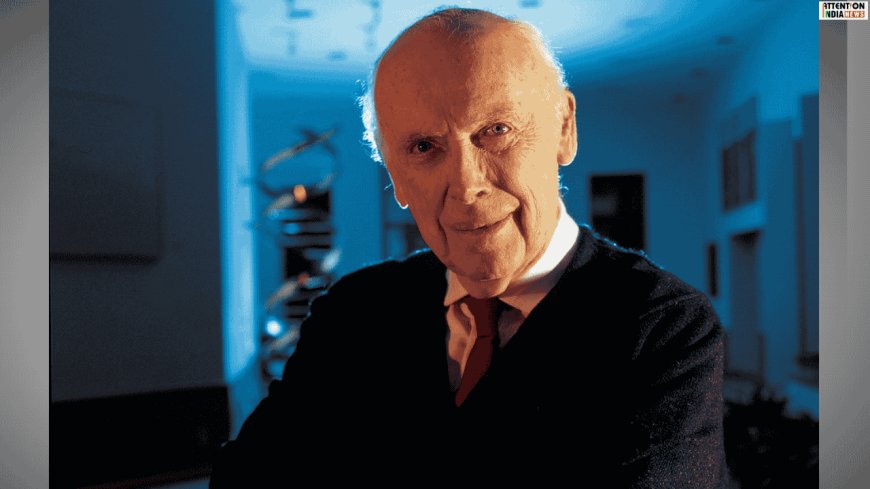
New Delhi (India) November 8: James D Watson is gone. He was 97 years old. The news was confirmed by Cold Spring Harbor Laboratory on Long Island, where he had spent much of his life.
Early Life and Spark of Curiosity
James Watson was born on April 6, 1928, in Chicago. He was a tranquil child, surrounded by books and curiosity, and Sundays spent bird-watching instilled an early love for patterns in nature.
The New York Times said that he was the man who masterminded one of the most important scientific expeditions of the 20th century. He died this week in a hospice on Long Island. He had won a Nobel Nobel Prize in 1962 for DNA structure discovery.
Revolutionizing Modern Biology
James Watson carried his fame to the classroom, and laboratory. At Harvard, he brought molecular biology right into the heart of modern science.
Later, as director of the Cold Spring Harbor Laboratory, he turned that quiet institute into a world center of genetics.
His ambition was a driving force behind the fledgling movement that evolved into the Human Genome Project — mankind’s initial effort at reading its own blueprint.
Controversy and Consequences
In his old age, he was probably as famous for his racists and scientifically unfounded comments about race and intelligence as for anything else.
Starting in the late 2000s, he offered a series of public statements suggesting that differences in intelligence among racial groups are based on genetics — claims refuted by the scientific community and lacking empirical backing.
The Rise and Fall at Cold Spring Harbor
His remarks, initially reported by The Sunday Times in 2007, were met with immediate and widespread criticism. Cold Spring Harbor Laboratory, where he was director and later president, suspended him, and he resigned from his administrative positions.
Years later, in 2019, the flames were fanned again by a PBS documentary when Watson was once more interviewed, reiterating those views on camera. Cold Spring Harbor’s answer was to revoke his remaining honorary titles.
Other institutions that had once embraced him pulled away. Former colleagues denounced his comments as not only offensive but scientifically inaccurate.
A Complex Legacy
Now, his public legacy is in two awkward pieces — on one side, the young researcher who helped pull back the curtain on DNA’s structure, a finding that transformed medicine and genetics and the story of life.
On the other is an old man whose remarks have caused great pain and whom he ultimately turned away from the very institutions he played a role in building.
What will be left of James Watson? His was a mind that changed the face of biology; his a voice that cut him out of his proper place in history; his a story which compels us to hold brilliance and failure simultaneously.
With the discovery of the double helix, he unlocked one of nature’s biggest secrets, but only to prove that knowledge in itself does not teach empathy or wisdom.